

A day in the life of HR teams: lots of coordination, little time for people
A recruiter who has to screen 300 applications for a single role. An HR manager juggling interview slots between three people and one candidate. An onboarding process that runs across four departments, with no one holding the full picture. These aren't edge cases — they're business as usual in many HR departments.
monday.com positions its AI features for HR around exactly this problem: not as a replacement for people decisions, but as relief from the coordination work around them. The platform brings this together in four building blocks: monday sidekick, AI Blocks, monday vibe and dedicated HR agents.
monday Sidekick for HR: the AI assistant for people data
Sidekick is the chat-based AI assistant that draws directly on the data in your workspace. For HR teams, that means:
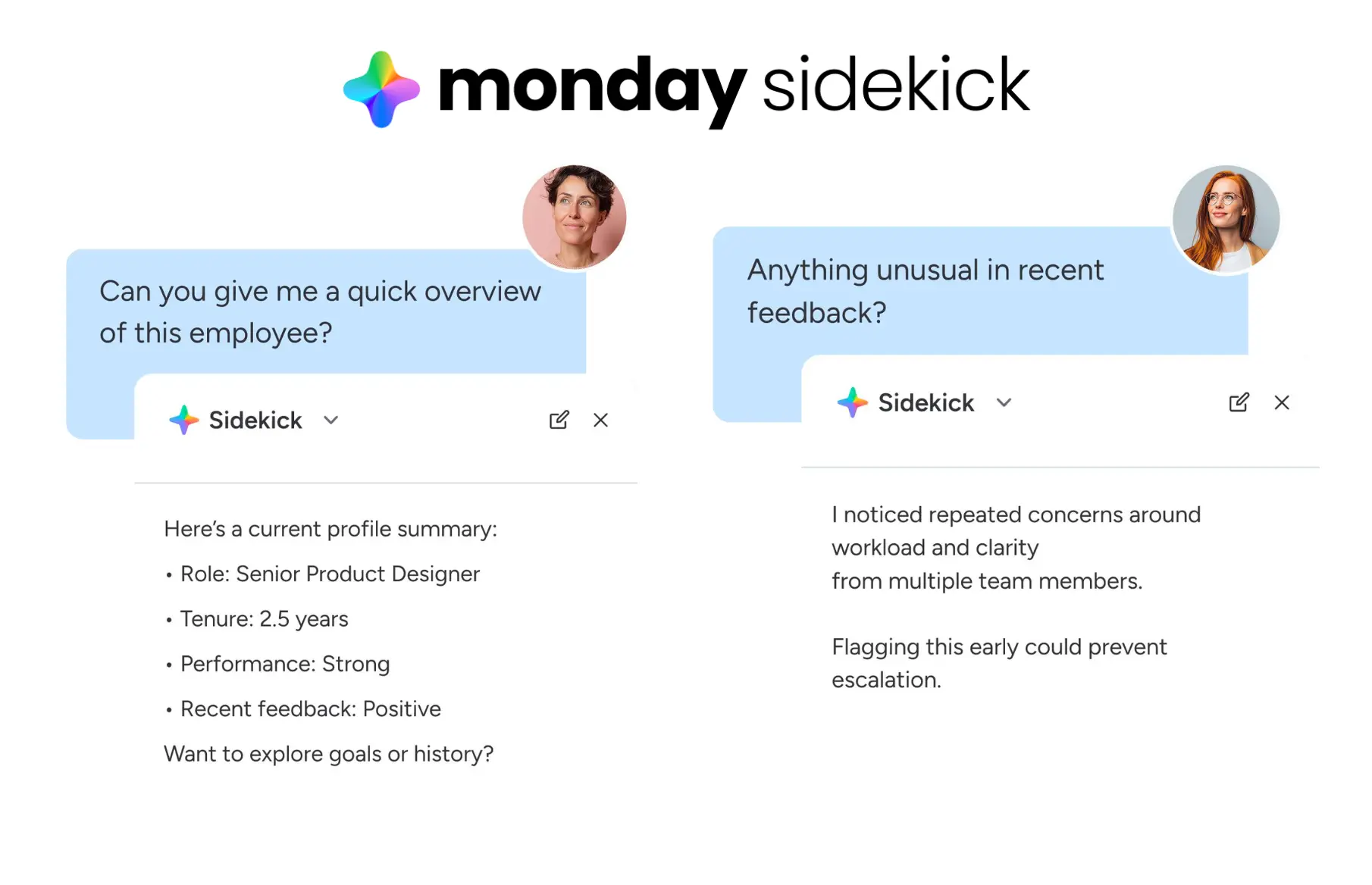
Summarising profiles: Instead of manually digging through an employee or candidate record, you simply ask Sidekick for a summary. The tool returns role, tenure, performance assessment and the latest appraisal feedback in seconds.
Data stays current, without manual effort: Sidekick automatically reconciles people data and HR workflows with reality, for example when an application status changes or a deadline passes.
Early warning signs instead of surprises. Sidekick spots patterns in feedback, engagement and workload, and flags it when the same concerns keep coming up across multiple check-ins, for example around workload or lack of clarity on tasks. That gives HR and managers a chance to act before something escalates, not after.
monday AI Blocks: ready-made AI building blocks for existing workflows
AI Blocks are individual, ready-to-use AI actions that you drop into an existing workflow without having to rebuild it. Three are particularly relevant for HR:
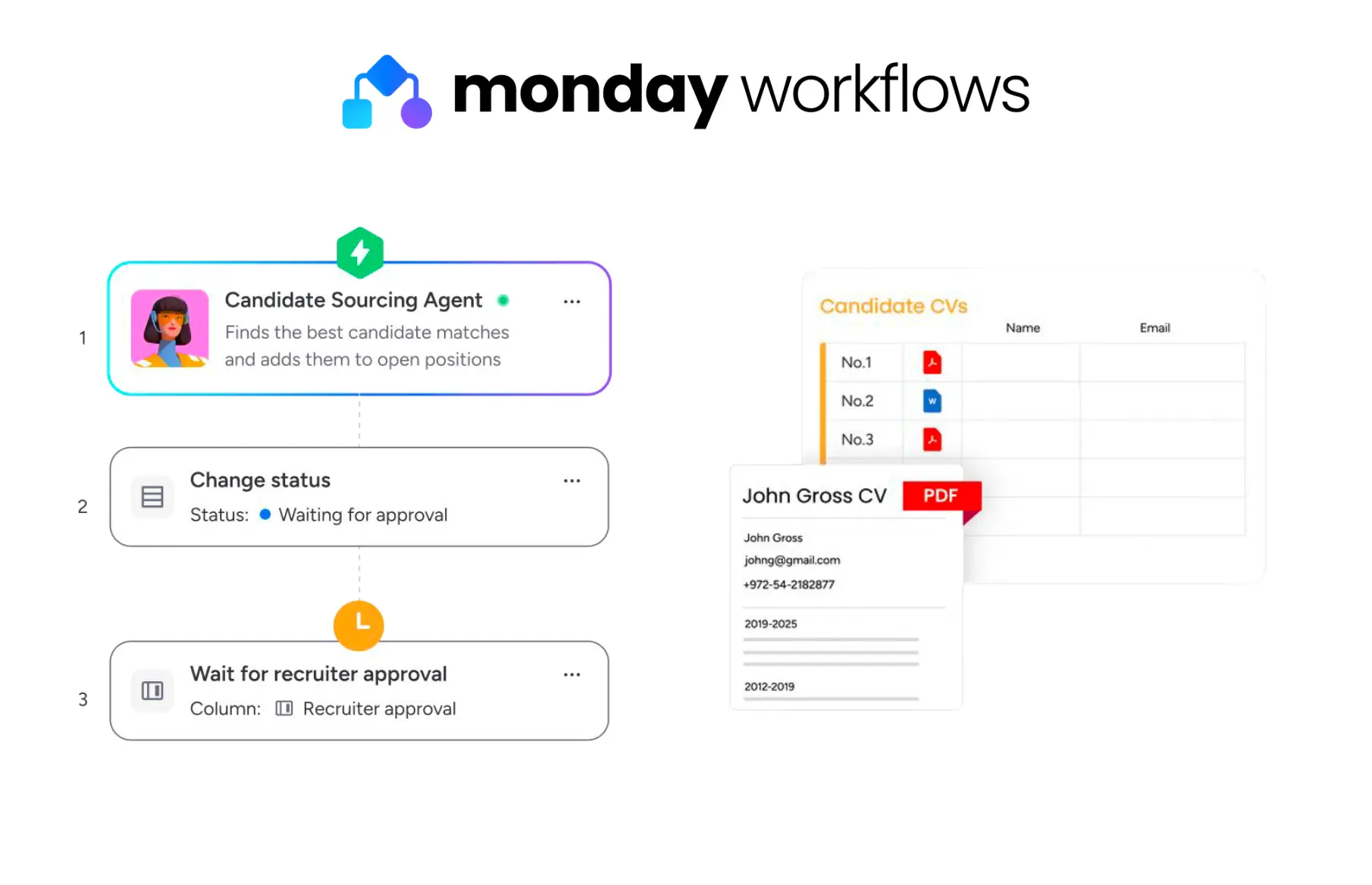
CV to profile: The block extracts key data from a CV (name, contact details, work experience, education) and automatically turns it into a structured candidate profile. No more manual data entry.
Early risk detection: The block analyses incoming feedback for sentiment shifts and recurring patterns before they turn into a bigger problem.
Smart request prioritisation: HR requests (such as time-off requests or onboarding tasks) are automatically sorted by urgency and routed to the right person.
The three HR agents in detail
While Sidekick and Blocks handle individual tasks, agents work through an entire sub-process end to end, including handover points where a person makes the final call.
Candidate Sourcing Agent
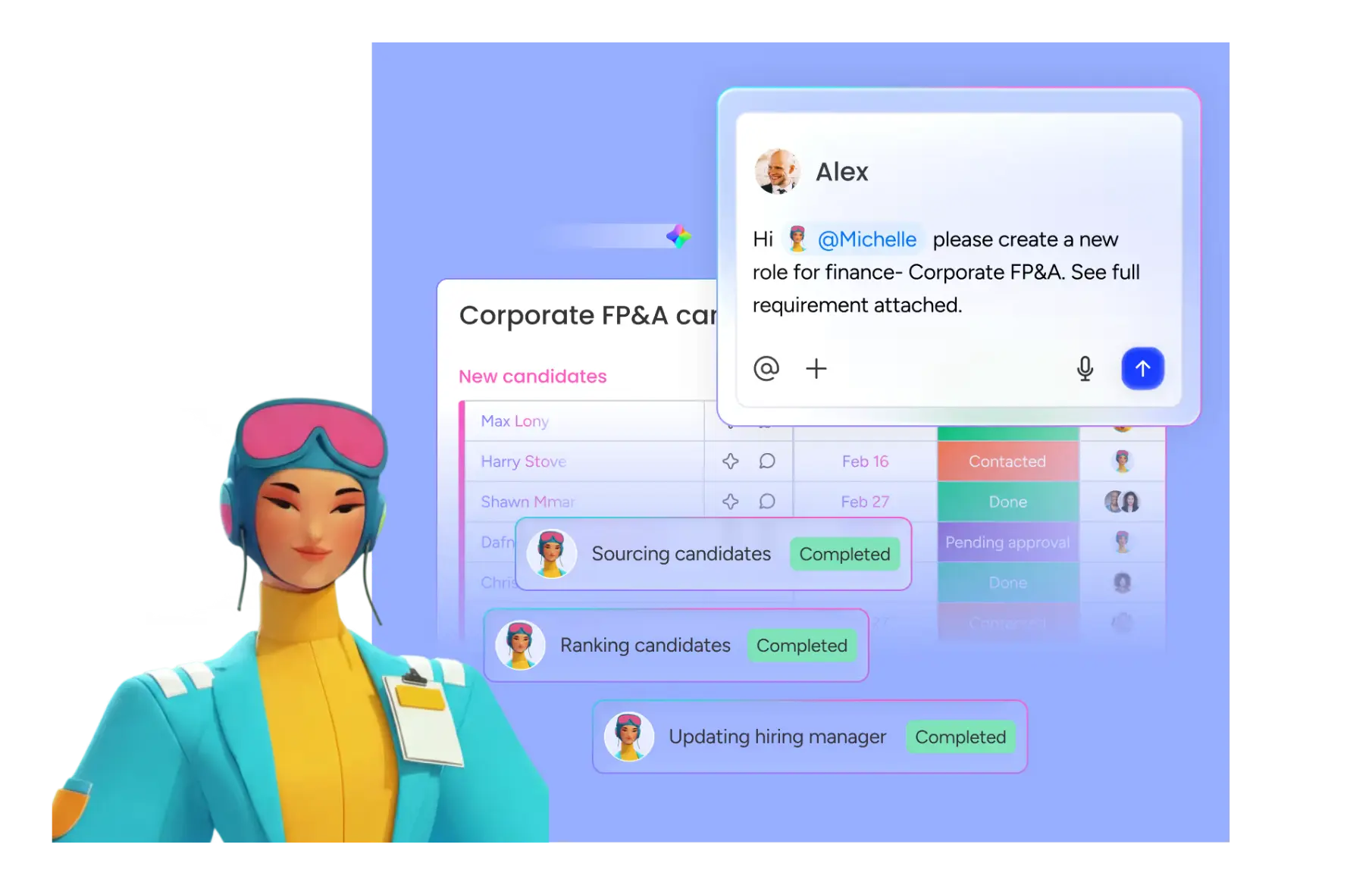
The agent searches multiple sources (LinkedIn, job boards, referrals) in parallel, ranks candidates against defined criteria, and learns from recruiter feedback over time. Once the recruiter approves, it reaches out to candidates with a personalised message sequence. The recruiter reviews the suggested shortlist and focuses on the conversations that actually matter, rather than the search itself.
Candidate Screening Agent
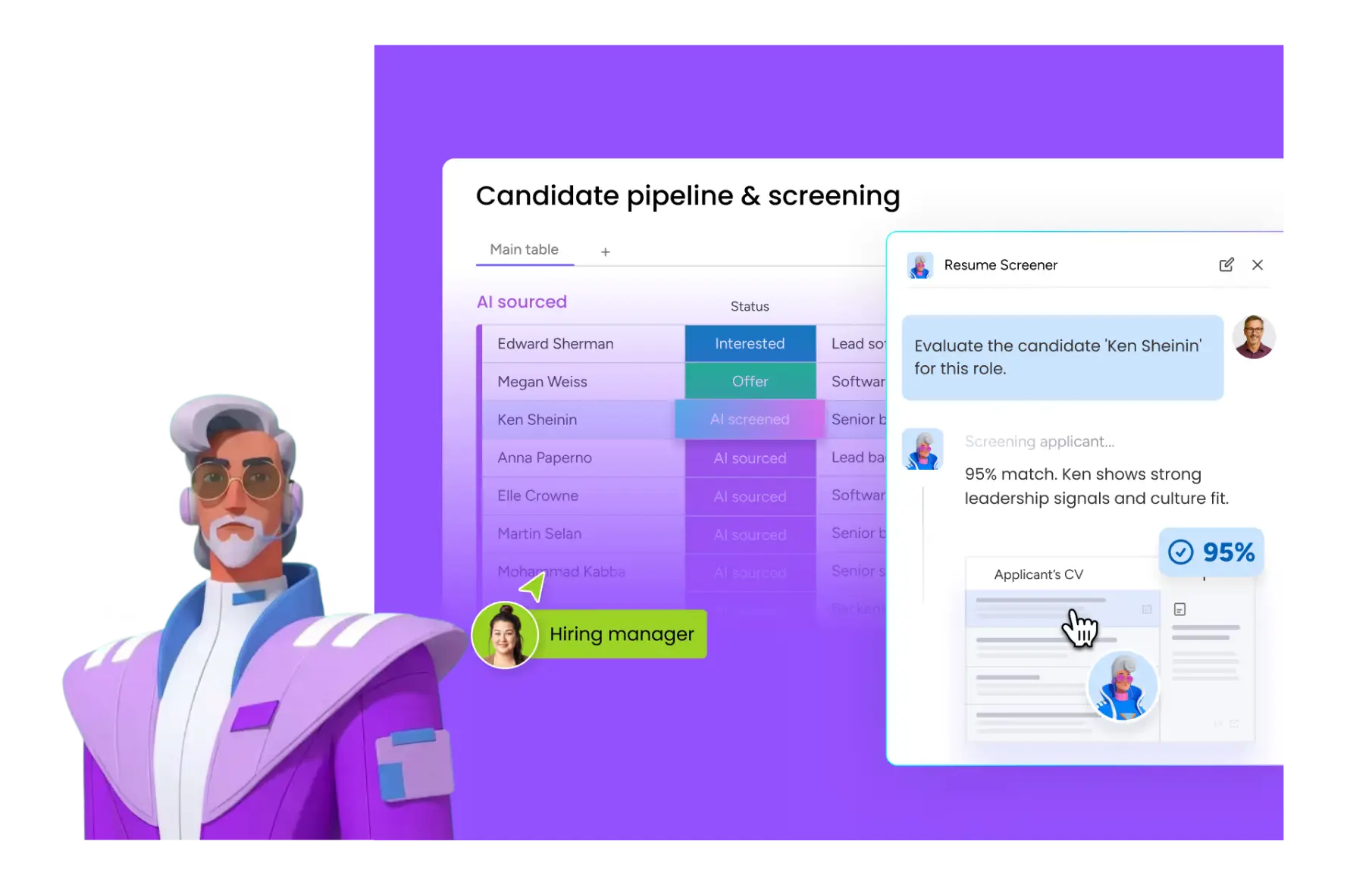
When 300 applications come in for a role within 48 hours, things get unmanageable fast without automation. The screening agent scores every application against the role's defined criteria, automatically flags the strongest candidates for the next round, and notifies unsuccessful applicants directly. The recruiter only sees the pre-filtered, criteria-based matches and can focus on assessment rather than sifting through applications.
Interview Scheduling Agent
Finding a slot across several rounds of interviews often takes longer than the interview itself. The scheduling agent automatically matches candidate and interview-team availability, lets candidates book themselves into open slots, and handles confirmations, reminders and rescheduling without manual input. The team sees the results on the board, without the coordination overhead.
Worth noting: monday.com has expanded its agent line-up since the initial launch. Alongside the three agents above, there's now also an onboarding, a coordinator, a feedback and a knowledge agent for HR. If you want to cover the whole recruiting funnel, you can combine these building blocks as needed rather than sticking to just three agents.
monday Vibe: build your own HR tools without code
monday Vibe is monday.com's no-code app builder. For HR teams, that means describing what you need is enough to get a tailor-made app, no IT ticket required. Three real-world examples that monday.com itself showcases:
An organisational chart that updates automatically as the company structure changes. An employee resource portal where staff can find policies, guides and answers themselves instead of asking HR. An onboarding command centre that tracks every new hire from day one, with open tasks, owners and blockers.
What monday AI costs for HR use
monday.com uses a single credit system across all its AI features (Sidekick, AI Blocks, Agents, AI Notetaker, monday vibe, AI Workflows). Buying a plan gets you both user seats and a monthly credit allowance:
- Basic: 1,000 credits per month
- Standard: choose between 2,000, 4,000 or 8,000 credits
- Pro: choose between 3,000, 4,000, 8,000 or 20,000 credits
- Enterprise: a custom allowance, available only through sales
Consumption varies a lot by feature: an AI Block costs around 8 credits per action, while the AI Notetaker uses roughly 120 credits per hour. Sidekick and the agents range from 10 to over 250 credits depending on how complex the request is. For an SME with only a few open roles, the Standard allowance is often enough; if you're recruiting for several roles at once, it's worth looking at Pro. monday.com doesn't publish exact CHF prices for credits — only the current pricing page, since the tiers change regularly.
In practice: how Blinno implements monday.com HR workflows for SMEs
As a monday.com Platinum Partner, Blinno implements HR workflows like these for Swiss SMEs, from automating the recruiting process to connecting HR boards with existing Finance or IT systems. Over 400 integrations can be connected to monday.com, so an HR agent doesn't work in isolation — it can, for example, hand an onboarding task straight to IT or payroll. Across more than 638 completed projects, the pattern holds: the bigger lever is rarely the individual agent, but how smoothly the boards, automations and integrations behind it work together.
Conclusion
monday AI doesn't replace people decisions. It takes over the coordination work either side of them: finding and shortlisting candidates, matching schedules, keeping data current, and spotting early warning signs. For HR teams filling several open roles at once with limited resources, that's a real time saving, not a marketing claim. If you want to find out whether it's worth it for your team size and recruiting workload, Blinno offers a no-obligation consultation.
.svg)