

Most businesses we talk to already have AI in-house. Not as a project, but as a habit: someone in marketing drafts text with it, someone in sales has proposals checked over, someone in support translates replies. What's missing isn't the technology, and usually not willingness either. What's missing is the structure around it.
That's exactly where the difference begins between a business that's measurably faster after twelve months and one that's left with a pile of unused licences after twelve months. That's why we've organised our approach into four phases. Each has a defined outcome, and none gets skipped.
Why it doesn't work without a sequence
The most common starting point in SMEs is the purchase. Someone decides the business now needs AI, licences get handed out, a two-hour training session takes place. After that – nothing measurable happens. Not because people are unwilling, but because nobody defined which concrete task was meant to get better.
The second most common starting point is the policy. Leadership notices staff using private accounts, gets alarmed, and bans it. The problem doesn't disappear, it just becomes invisible.
Both routes fail at the same point: they address a symptom rather than a process. That's why, for us, analysis comes before everything else.
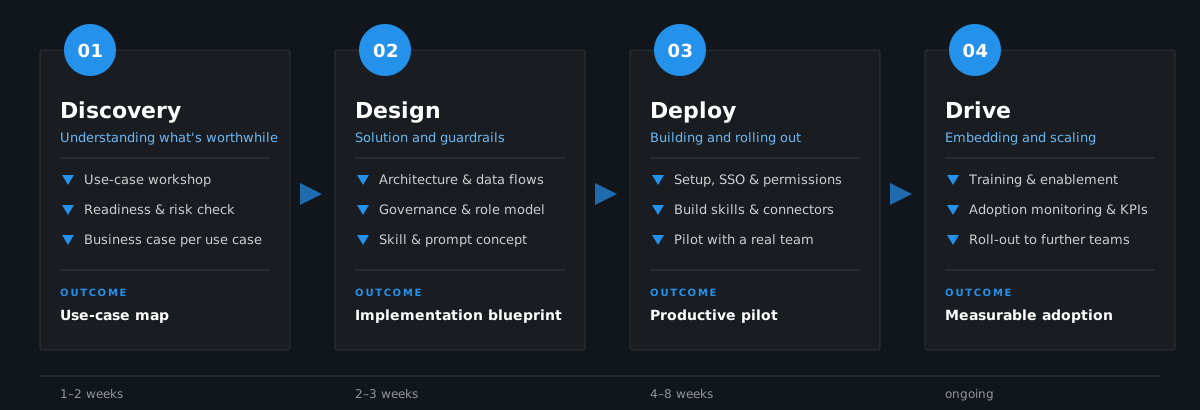
Phase 1: Discovery – understanding what's worthwhile
The first phase isn't about tools, it's about bottlenecks. Where does waiting time build up? What task does someone do by hand every week, even though it follows the same steps each time? Where does quality cost time because four people check the same document?
Then comes an honest look at the starting position: where does the data needed for a use case actually sit? Is it even accessible? Who decides on approvals? Which data classes must never leave the building? And – a point almost everyone underestimates – who in the business actually has time to support a rollout?
At the end of this phase there's no presentation, but a prioritised use-case map: a list of applications, each with a rough estimate of effort, benefit and risk. This typically takes one to two weeks.
What regularly happens here: two or three of the originally named ideas fall away, because it turns out the real problem is a missing interface rather than missing intelligence. That's not a setback – that's money saved.
Phase 2: Design – solution and guardrails
Only once it's clear what should be built is it decided how. In this phase the target architecture and data flows take shape: which system supplies which information, where does processing happen, what happens to the results.
In parallel – and this is the part that's easily forgotten – the governance and role model takes shape. Who's allowed to use what? Who signs off? What happens if a result is factually wrong? Who's responsible if a staff member acts on a mistake the AI produced?
Clarifying these questions later is expensive. Clarifying them beforehand costs a few workshop hours. That's why we handle them alongside the technical work, not afterwards.
The third component is the concept for reusable capabilities: which workflows should be fixed so they run the same way every time – with your templates, your tone, your quality criteria? The outcome of this phase is an implementation blueprint. Two to three weeks.
Phase 3: Deploy – building and rolling out
Now the setup happens: company accounts, sign-in via your existing identity provider, permission structure, connecting the systems defined in Phase 2. The first capabilities are then built and tested.
What matters most comes next: a pilot with a real team and real tasks. Not with demo data, not with just the most enthusiastic staff member, but with a group that has to carry the process through even when things get hectic. A pilot that only works under ideal conditions hasn't proven anything.
In this phase, findings almost always come back that nobody had on their radar beforehand – usually around data quality, or workflows that play out differently in reality than on the process diagram. That's why this phase takes four to eight weeks, not two.
Phase 4: Drive – embedding and scaling
The last phase is the one most often missing – and the most common reason good pilots stall. This is about training that's role-specific rather than generic, building internal champions who help with questions, and measurement.
Measurement means: is the thing actually being used? Not "were licences handed out", but how many people use it weekly, for which tasks, with what outcome. Where the numbers hold up, it's rolled out to further teams. Where they don't, questions get asked and adjustments made – or the use case gets stopped. That's a legitimate outcome too.
This phase doesn't end. It moves into ongoing operation.
What this means for your timeline
From the first analysis to a productive pilot, realistically two to four months pass. Anyone wanting to go faster either skips Discovery – and ends up building something nobody needs – or skips Drive, and ends up with something good that nobody uses.
The good news: the phases can be commissioned individually. Many businesses start with Discovery and then decide, without pressure, how far they want to take it. A clean result from Phase 1 is valuable even if the final decision is to wait another six months.
The next step
If you want to know where your business stands today and which two or three use cases would pay off fastest: we do this in a free 45-minute introductory call. Afterwards you'll have an assessment – and no obligation.


.svg)