



Claude in 90 Seconds
Claude is Anthropic's AI assistant. For businesses, four building blocks matter – no more technical detail is needed to decide.
Models
Different model classes – from fast and low-cost through to complex reasoning for demanding, multi-step tasks.
Projects & Connections
Self-contained workspaces with their own knowledge base. Connectors link your systems via MCP – Claude works with your data instead of copy-paste.
Skills
Reusable capabilities with instructions, templates and scripts. Claude loads them automatically when they fit the task – your process knowledge becomes a function.
Claude Code & Agent SDK
For anything beyond chat: Claude carries out tasks independently, works with files and tools – even embedded in your own applications.
That was the technical part. The more interesting question is what you do with it – and how you roll it out in an organised way.
The Problem Isn't the Technology
In almost every business we talk to, someone is already using AI. Yet little actually changes as a result. Usually for three reasons.
A Tool Without a Process
Licences are handed out, but nobody has defined which process is actually meant to get faster. Usage stays down to chance.
Shadow AI
Staff use private accounts because nothing official exists. Company data ends up in tools nobody has approved.
The Pilot That Never Scales
One department builds something impressive. Without a role model, training and an operating concept, it stays a one-off.
The Blinno Claude Framework
Four phases, one thread running through them. Each phase has a defined outcome, so you always know where you stand and what comes next. No big bang – controlled steps with measurable value.
Discovery
Understanding what's worthwhile
Design
Solution and guardrails
Deploy
Building and rolling out
Drive
Embedding and scaling
Discovery → Design → Deploy → Drive: from potential analysis to measurable adoption.
Understanding What's Worthwhile
We look at your processes and identify use cases with real leverage. Alongside that comes an honest readiness and risk check: where the data sits, who decides, and what must never happen.
Solution and Guardrails
Target architecture, data flows, the role and governance model, plus the concept for skills and connectors. The result is a blueprint you can actually implement – not a slide deck.
Building and Rolling Out
Setup, SSO and permissions, connecting your systems, building the first skills. Then a pilot with a real team and real tasks – not demo data.
Embedding and Scaling
Training, internal champions, monitoring actual usage. What works gets rolled out to further teams. What doesn't gets adjusted or stopped.
What We Offer Around Claude
Bookable individually or as full support across all four phases. Most clients start with consulting and training, then build from there.
Consulting & Strategy
Training & Enablement
Build & Integration
Skills & Custom Agents
What a Skill Looks Like in Practice
A skill isn't a chatbot. It's a fixed workflow that Claude carries out the same way every time – with your templates, your tone of voice and your quality criteria.
Quotes and Cost Estimates
A requirements list becomes a structured estimate with a range, cost blocks and open questions – in your own template's layout.
Benefit: from hours to minutes, with consistent structure and less forgotten.
Support and Enquiry Triage
Incoming enquiries are categorised, enriched with context from the CRM, and answered as a draft – sign-off stays with a person.
Benefit: shorter response times, consistent answers, less routine work.
Project and Meeting Documentation
Transcripts and notes become a summary, decisions and tasks – logged directly as items on the project board.
Benefit: traceable projects, without anyone writing up minutes in the evening.
Knowledge Search Across Your Own Records
Claude searches connected drives and systems and answers questions with a source reference instead of from memory.
Benefit: answers in seconds – and traceable back to their source.
Introducing AI Without Giving Up Control
For leadership, this is usually the deciding question. We answer it across four levels – from people to systems. Technology alone isn't enough, and neither are policies alone.
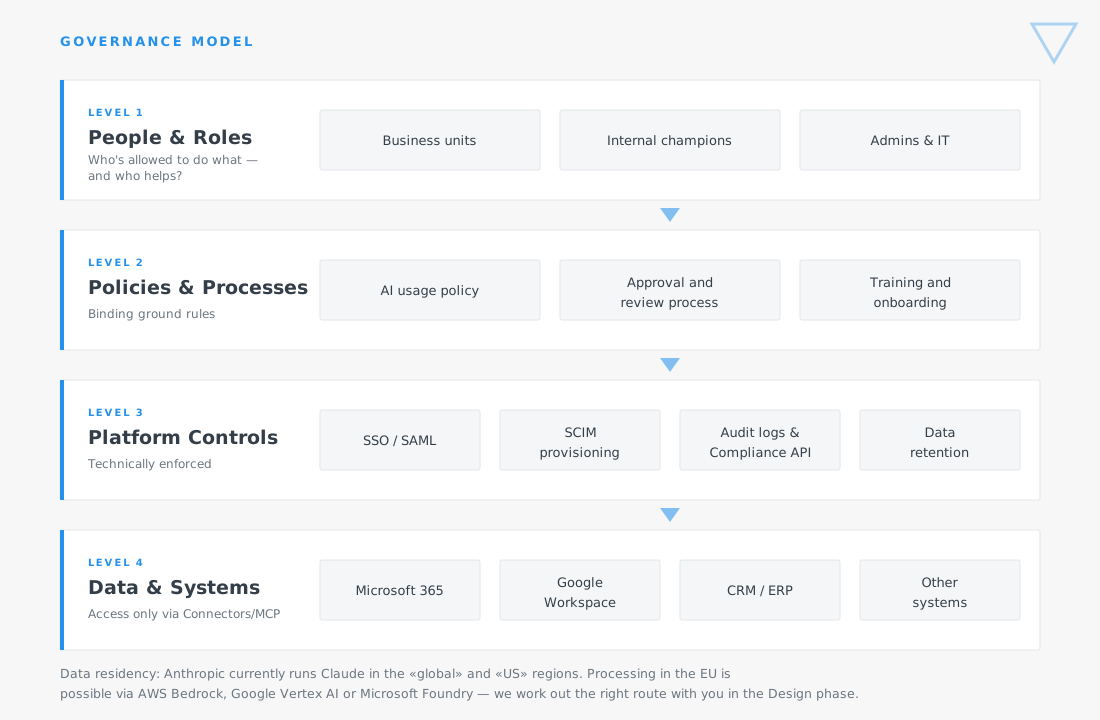
Data residency: Anthropic currently runs Claude in the «global» and «US» regions. Processing in the EU is possible via AWS Bedrock, Google Vertex AI or Microsoft Foundry – we work out the right route with you in the Design phase.
Governance model: each level has defined owners and checkable control points.
What Anthropic Brings – and What You Need to Define Yourselves
As of September 2026. All details from official Anthropic sources.
SOC 2 Type I and Type II, ISO/IEC 27001:2022 and ISO/IEC 42001:2023 for AI management systems. HIPAA configuration with a BAA is possible. Evidence available via Anthropic's Trust Center.
With commercial use (Team, Enterprise, API), your content is not used to train the models by default. For personal consumer accounts, that only applies with explicit consent – one reason shadow AI is a genuine risk.
In commercial use, inputs and outputs are deleted after 30 days by default. Enterprise customers can configure their own retention period (minimum 30 days). For API use, Zero Data Retention is available on request.
Anthropic currently runs Claude directly in the «global» and «US» regions – there's no Swiss region. Processing in the EU is possible via AWS Bedrock, Google Vertex AI or Microsoft Foundry. We work out which route suits you in the Design phase, before anything gets set up.
SSO/SAML with common identity providers, SCIM provisioning, roles and workspaces, usage analytics, and a Compliance API to connect to your SIEM.
An AI usage policy, an approval and review process, mandatory training, defined permitted data classes, and a named owner. That's exactly what we build with you – it's the part no platform does for you.
„We didn't just buy Claude – we first understood where it would genuinely help us. Blinno guided us through that prioritisation and then set it up properly, including the rules for who's allowed to do what. Today our team works with it without us having to worry about data protection.“
AI Isn't a New Line of Business for Us
We've been automating business processes for Swiss SMEs for years. Claude isn't an end in itself for us, but another building block in a landscape we already know well.
Process First, Tool Second
We first ask which process should get better. Often the best answer is automation without AI – and we'll tell you that too.
We Connect to What You Already Use
Microsoft 365, Google Workspace, your CRM or ERP, project and filing systems: Claude gets connected wherever your data and processes already run – via connectors, MCP, or directly through your system's API.
We Use It Ourselves
Our own quotes, research and internal processes run through Claude and our own skills. What we recommend, we've already used ourselves.
Book Your Free Introductory Call Now
tbd
The Claude Readiness Check
Free and no obligation!
In 45 minutes, we'll look together at where AI is already in use at your business today, which two or three use cases would pay off fastest, and which governance questions you should clarify first. Afterwards you'll know whether and how a project makes sense – with no obligation.

Frequently Asked Questions
Still not sure whether Claude is the right choice for your business? Here we answer some of the questions you might have:
We already use ChatGPT or Copilot. Why Claude?
It doesn't have to be either/or. Claude is particularly strong with long documents, multi-step tasks and connecting your own systems via MCP. In the readiness check, we look with an open mind at which tool fits which use case – and whether running both in parallel is even worthwhile.
How long does a rollout take?
Discovery and Design together typically take three to five weeks. A productive pilot is usually up and running after a further four to eight weeks. The roll-out to further teams then continues step by step.
What does it cost?
That depends on scope – a Discovery workshop sits in a different order of magnitude to a full rollout with your own skills. After the initial call, you'll get an effort estimate with a range and clear cost blocks. Anthropic's licence costs come on top, separately, based on plan and usage.
Does our data stay in Switzerland?
Anthropic doesn't currently offer a Swiss region. Depending on your requirements, processing in the EU is possible via AWS Bedrock, Google Vertex AI or Microsoft Foundry. We clarify your regulatory requirements in the Design phase and choose the delivery route accordingly – before anything is set up.
Do we need to clean up our data first?
No, but it helps. We deliberately start with use cases that work with what's already there today. We do structural data work where it has the biggest leverage – not as a precondition for getting started at all.
What happens if our staff don't get on board?
That's the most common reason rollouts stall – which is why the Drive phase is a fixed part of the framework. We train by role, build internal champions, and measure actual usage instead of assuming it.