
The client is one of the world's leading automotive manufacturers, headquartered in Germany with over 150,000 employees worldwide. As a global group with complex, highly regulated HR and payroll processes, the company needs automation solutions that don't just speed up individual tasks, but are also secure, traceable and maintainable by internal teams in the long run.
Initial situation
Several recurring HR processes ran manually and on paper, or involved media breaks between different systems, making them labour-intensive, error-prone and hard to scale. At the same time, the company needed to roll out a new no-code automation platform (n8n) group-wide and in a compliant way: with clear governance rules, a clean separation between development and production environments, and a sign-off process the whole group could rely on – before the first process even went live.
Solution
Blinno supports the automotive manufacturer with an agile consulting team of automation experts and strategy consultants, working in a phased, iterative approach:
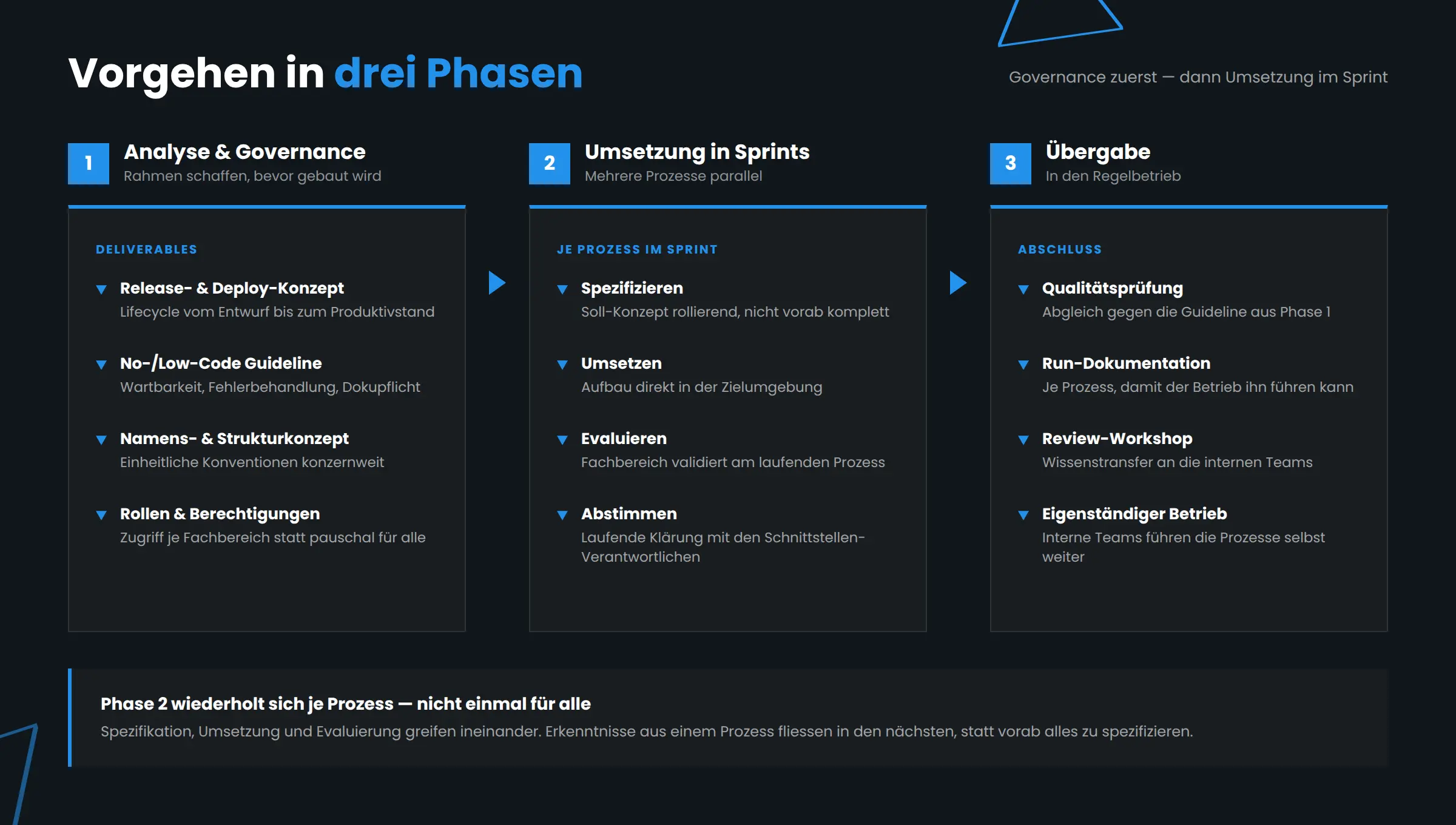
Phase 1 – Governance & lifecycle design
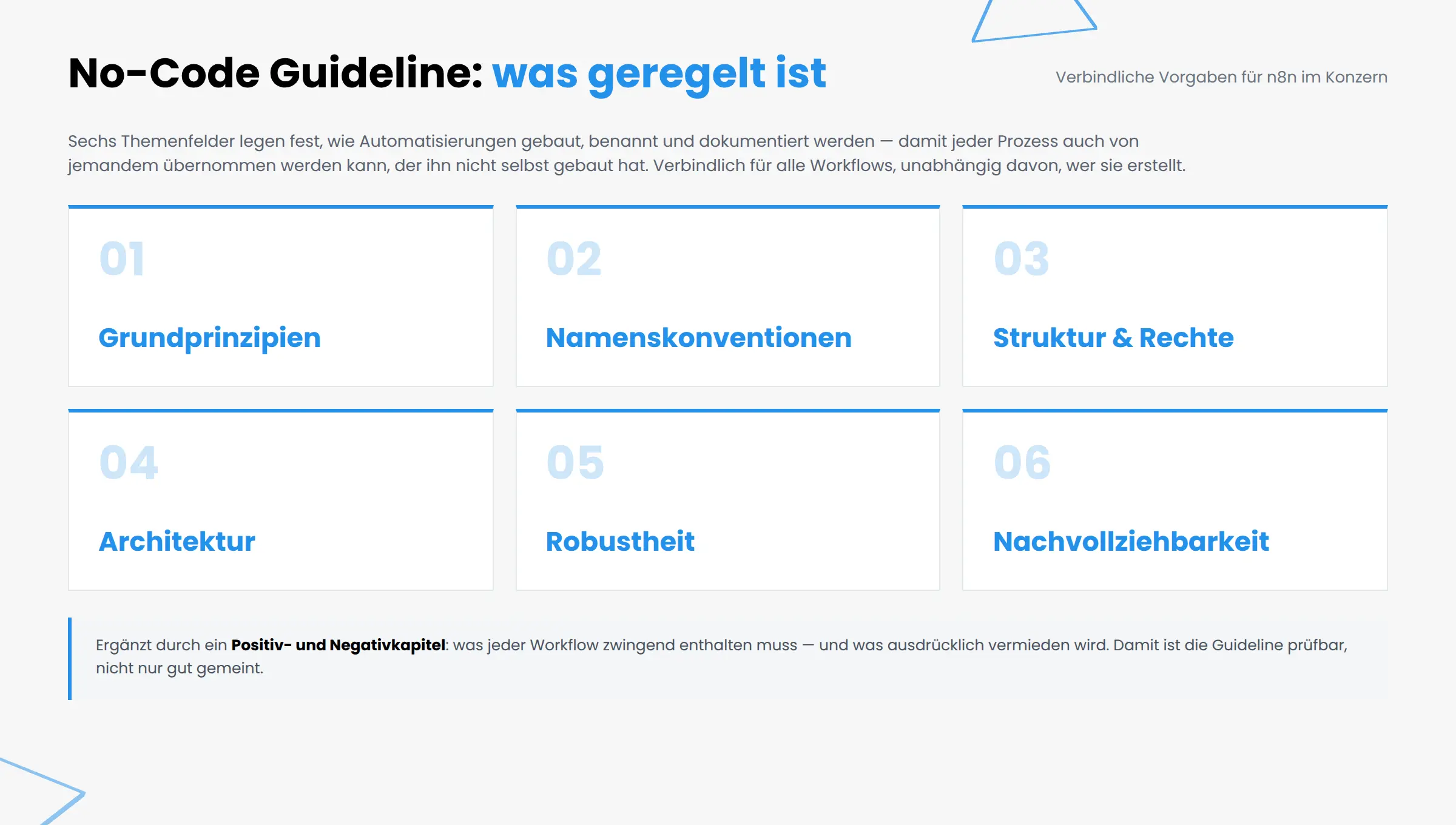
Before building any live processes, Blinno laid the groundwork: a release and deployment concept for n8n (DEV/PROD separation, Git versioning), a no-code/low-code guideline for maintainability and error handling, and standardised naming conventions for workflows, modules and variables.
Phase 2 – Agile delivery of the core processes
Several prioritised HR processes were specified, built and validated in parallel rather than sequentially, each evaluated directly with the business departments instead of following a rigid waterfall approach.
Phase 3 – Documentation & handover
Every process built is also checked against the governance rules, properly documented (run documentation) and handed over to day-to-day operations in a closing workshop.
At the core of the solution is a well thought-out operating model for n8n at enterprise level:
- Naming conventions for workflows, modules, access and tags, so every process can be understood and taken over by people who didn't build it.
- Separate environments (DEV/PROD) with Git versioning, so changes reach production in a controlled and traceable way.
- Structured sign-off process: every process is checked both technically and by the business before going live – with no dependency on the development team.
- Robust, multi-layer error handling: automatic retries, targeted handling of expected exceptions, and a central escalation mechanism for unexpected errors.
- Data protection and traceability by default: personal data is masked in the automation logs, retention periods are kept short, and business data stays in its source systems.
-
The governance framework in place also means further automations can be added following the same proven pattern. A central error-handling concept ensures that failures in individual cases don't block the whole process and are automatically escalated to the right place.
* Use cases delivered: Governance and lifecycle design for n8n (DEV/PROD, Git versioning), naming conventions for workflows and modules, agile delivery of prioritised HR processes, structured technical and business sign-off process, multi-layer error handling with escalation, documentation and handover to operations.
.svg)