

“Self-hosted is free” is one of the most expensive misconceptions about n8n. The software licence may cost nothing, but the bill behind it does not. This article calculates at which execution volume self-hosting actually pays off and when the cloud version stays cheaper.
The three cost blocks
1. Licence and plan
n8n Cloud is tiered by monthly workflow executions. As of September 2026 it roughly has four levels: an entry plan in the low double-digit euro range per month for a few thousand executions, a mid-tier plan of around 50 euros per month for ten thousand executions, a business plan in the high three-digit range for forty thousand executions, and an individually negotiated enterprise plan for large volumes. All cloud plans include unlimited users and workflows, and billing is based on executions. Always check the current figures on the official n8n pricing page before deciding, as the tiers change regularly.
The self-hosted Community Edition is free as software and fair-code licensed. If you need enterprise features such as SSO, extended permissions or support, you also pay a licence fee when self-hosting, which is negotiated separately.
2. Infrastructure
Self-hosted n8n needs a server, a database (Postgres is recommended for production, not SQLite) and usually a reverse proxy with TLS. Realistic orders of magnitude:
These figures are guide values for Swiss or EU hosting and vary considerably depending on provider, region and redundancy requirements. They do not replace your own calculation, but they give an order of magnitude.
3. Operations and maintenance
This is the block that is most often missing from calculations. Self-hosted n8n continuously needs:
- Updates: Installing new n8n versions, checking for breaking changes, testing node compatibility.
- Monitoring: Watching server resources, error rate and, in queue mode, the queues.
- Backups: Regular, tested backups of the database and credentials, including a restore test.
- Incident handling: Outages, failed executions, certificate renewal and capacity problems.
Realistically, the effort is 2 to 5 hours per month for a small set-up, 8 to 15 hours for a medium one, and 20 to 40 hours or a dedicated part-time position for a large, business-critical set-up. At an internal hourly rate of CHF 100 to 150, that quickly adds up to several hundred to several thousand francs per month, which appear in no pure infrastructure calculation.
Three scenarios calculated
Scenario 1: Small business
A few hundred executions per day, no dedicated IT person.
- Cloud: Entry plan, around CHF 25 to 30 per month, no operating effort.
- Self-hosted: Infrastructure CHF 20 to 50 per month plus 3 to 5 hours of operations at CHF 120 = CHF 360 to 600 per month.
- Result: The cloud is clearly cheaper here. Self-hosting does not pay off for this business, unless data protection makes it mandatory.
Scenario 2: Mid-sized company
Several thousand executions per day, an IT department with capacity.
- Cloud: Business plan, several hundred francs per month.
- Self-hosted: Infrastructure CHF 80 to 200 per month plus 8 to 15 hours of operations at CHF 120 to 150 = CHF 960 to 2,250 per month, plus infrastructure.
- Result: The calculation is closer. If the IT department plans the operating hours anyway (e.g. because it also looks after other systems), self-hosting can become economical. Without this synergy, the cloud often stays the better option.
Scenario 3: Large enterprise
Tens of thousands of executions per day, dedicated DevOps resources, compliance requirements (data residency, audit logs).
- Cloud: Enterprise plan, individually negotiated, often in the four-figure range per month.
- Self-hosted: Higher infrastructure costs, but the operating effort is already part of existing DevOps capacity. You also get full control over data residency and compliance.
- Result: Here the calculation usually tips in favour of self-hosting, not primarily because of cost, but because of compliance, scalability and control over governance processes.
Break-even: when does self-hosting pay off?
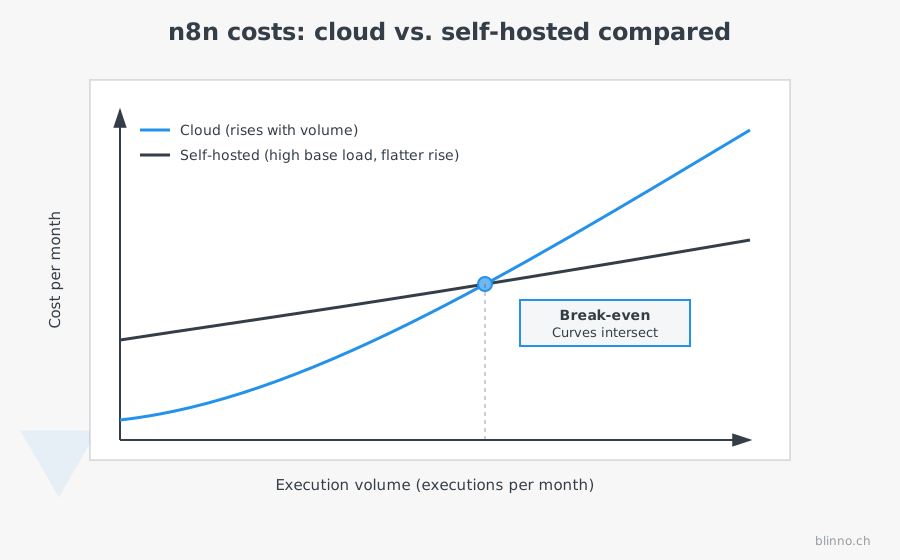
The cloud curve rises roughly in proportion to execution volume, because each tier costs more executions. The self-hosted curve starts with a higher base load (infrastructure plus minimum operating effort), but then rises much more gently, because a system that has been set up once can often handle additional volume without a proportional increase in effort.
For most organisations, the intersection lies between medium and large volume. That is where cloud plans move into the more expensive tiers and, at the same time, enough operating know-how is available so that the maintenance effort does not have to be bought in separately. Below that point the statement is clear: for many small and mid-sized businesses, self-hosting does not pay off. The supposed licence saving is eaten up by operating hours that are hard to free up in day-to-day work anyway.
Hidden cost factors
Besides the three main blocks, there are smaller items that add up: outgoing emails through an SMTP service, external APIs that the workflow calls, licence costs for monitoring tools such as Grafana or uptime checks, and the time needed to get new team members up to speed with a self-hosted environment. None of these items is large on its own. Together, though, they can make the difference between a narrowly positive and a narrowly negative break-even calculation. List these side costs as their own line in your calculation instead of quietly folding them into the infrastructure costs.
Another point concerns scaling within the cloud plans. If you are just over an execution limit, you often pay for the full jump to the next tier, even if only a few hundred additional executions are needed. So look at your actual usage over the last few months before you change plan. Peak months are not automatically the norm.
✨ AI generated content


